
The Cherry Blossom Ten Mile Run and the Army Ten-Miler are the two biggest ten-milers in the DMV. They cover the same distance in the same city, but the people who line up for them are not the same.
We pulled every finisher from both races from 2022 through 2026, 176,287 results in all, to see how they stack up.
The faster field
Cherry Blossom is the faster race, and it isn't especially close. Across all five years, the median Cherry Blossom finisher crossed in 1:36:37. The median Army Ten-Miler finisher took 1:40:26.
You might chalk that up to the makeup of the fields, since Army is about 60 percent men and Cherry Blossom is about 57 percent women. The gap holds when you compare like with like. Cherry Blossom men had a median of 1:29:14 against 1:35:20 at Army, and Cherry Blossom women ran 1:41:33 against 1:48:07. Split the fields by sex and ten-year age group and Cherry Blossom is faster in every one, by 3 to 10 minutes.
The front of the race is where the gap is widest. The top 10 men at Cherry Blossom average 46 to 47 minutes, while Army's top 10 average 50 to 51. Cherry Blossom's top 100 women average just under an hour. At Army, it takes about 1:06.
That gap at the front comes down to money. Cherry Blossom pays its elite field, with $6,000 to each open winner in 2025, and it has hosted the USATF 10 Mile Championships since 2023, which adds an American prize purse. The race also covers travel and lodging for men who can break 48 minutes and women who can break 56. Army's best-known competition up front is between military teams, like the All-Army squad, rather than pros chasing a check. The result shows up in the results. Cherry Blossom has had 270 to 380 runners break an hour every year, while Army has had 130 to 190.
The pros can't explain the middle of the pack, though. Even after removing the fastest 2,000 finishers from each race every year, Cherry Blossom's median is still about four minutes faster.
Deeper in the pack, 18 percent of Cherry Blossom finishers broke 80 minutes, compared with 13 percent at Army. At the back, Army has more runners out past two hours, roughly one in five in recent years against about one in eight at Cherry Blossom.
It isn't the course
A four-minute gap in the median would suggest Cherry Blossom is simply the quicker course. The runners who did both races say otherwise.
We matched 3,736 people who finished Cherry Blossom in the spring and Army in the fall of the same year, 4,638 pairs of races in all. Their median Army time was just 49 seconds slower than their Cherry Blossom time. Only 56 percent of them ran faster at Cherry Blossom.
The fast runners told the same story. Matched runners who broke 70 minutes at Cherry Blossom gave up only about 36 seconds at Army. Men lost a median of 35 seconds and women lost 1:13.
So if you know your Cherry Blossom time, you have a pretty good read on your Army time, give or take a minute. The difference between the two races comes down to who shows up.
Cherry Blossom highlights
Cherry Blossom grew 40 percent over five years, from 14,691 finishers in 2022 to 20,569 in 2026. Women make up about 57 percent of the field every year.
The field is also getting younger. Runners under 30 made up 26 percent of finishers in 2022 and 38 percent in 2026, and the median age dropped from 36 to 33. That younger, bigger field is a little slower. The share of finishers past two hours climbed from 10 percent to 14 percent.
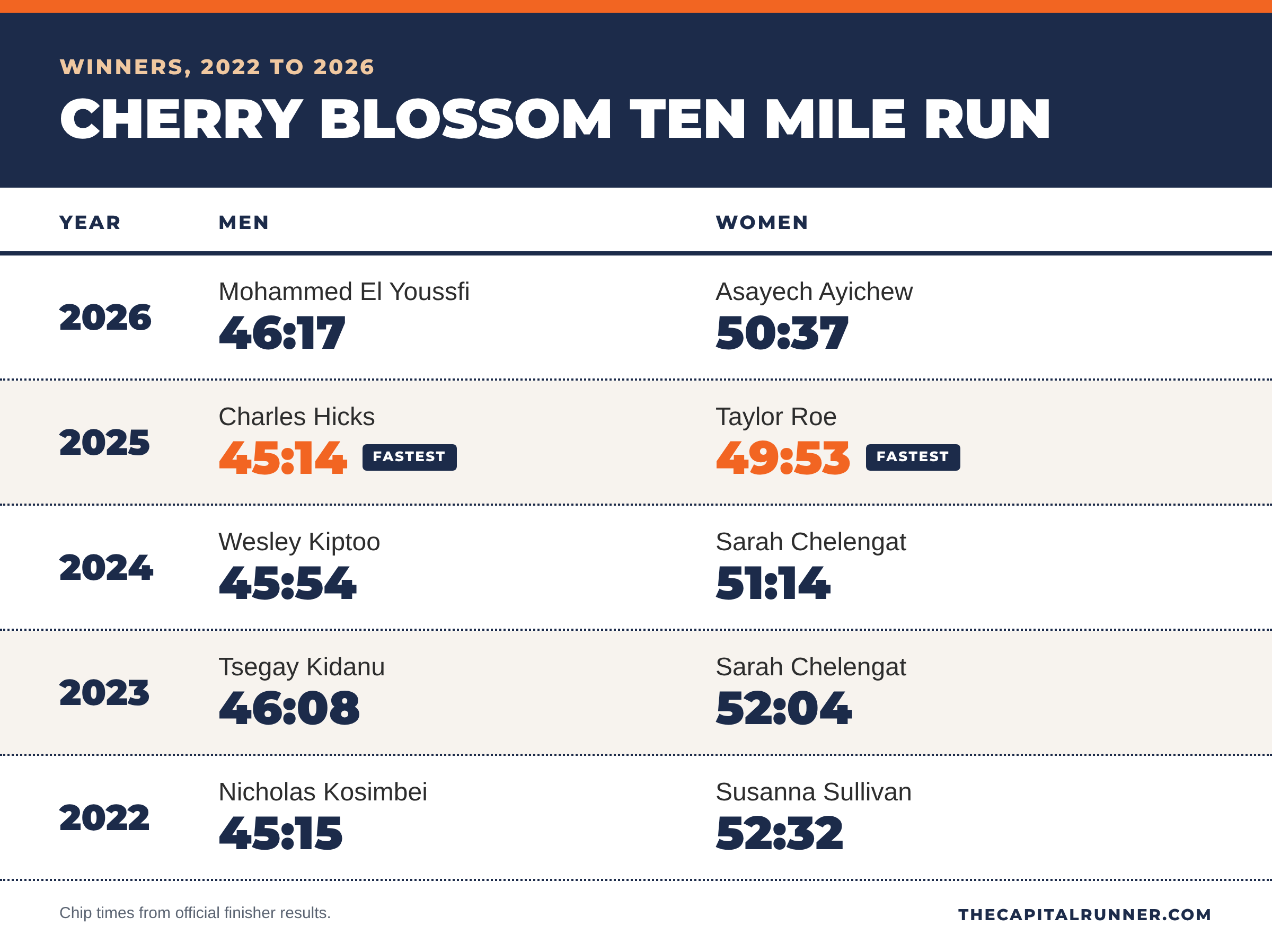
The winning times are a reminder of how deep the front of this race is. Charles Hicks ran 45:14 in 2025, the fastest men's time in our five years of data, and Taylor Roe ran 49:53 the same year, the only women's time under 50 minutes. Sarah Chelengat won back to back in 2023 and 2024.
Army Ten-Miler highlights
Army grew even faster than Cherry Blossom. It went from 12,008 finishers in 2022 to 19,232 in 2026, a 60 percent jump. Men make up about 60 percent of the field.
It also draws from farther away than you might think. About 61 percent of finishers list D.C., Maryland or Virginia as home, and Virginia alone accounts for more finishes than Maryland and D.C. combined. North Carolina, Pennsylvania, New York and Texas each send a few hundred runners a year.
2024 stands out as the slow year. The median finish was 1:42:28, the slowest of the five, and nearly a quarter of the field took longer than two hours. Cherry Blossom showed no matching dip that spring. Runners who did both races in 2024 lost 1:52 at Army, more than any other year, which points to something about that race day rather than a change in who signed up.
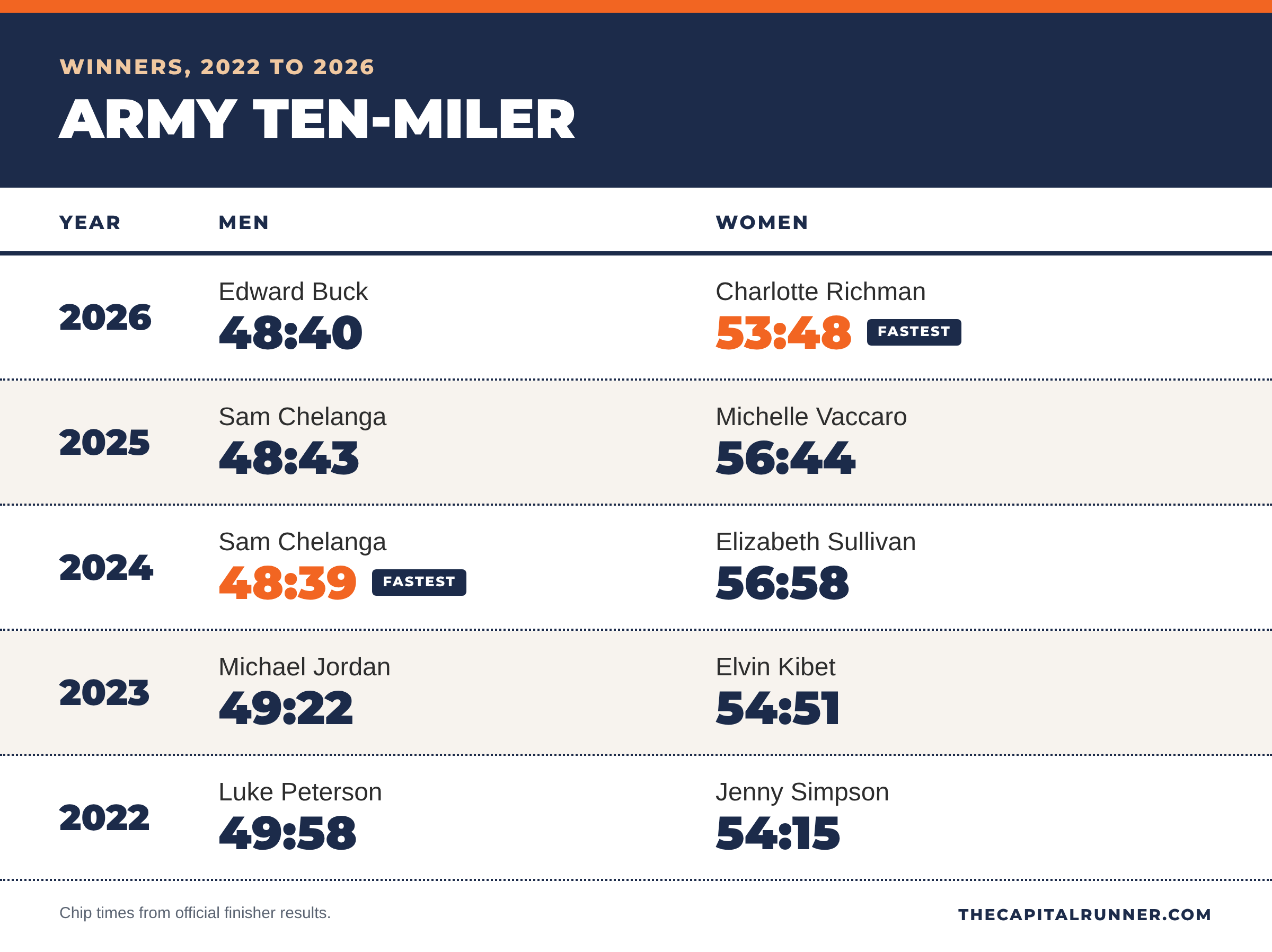
At the front, Sam Chelanga won in 2024 and 2025, at ages 39 and 40. Charlotte Richman's 53:48 in 2026 is the fastest women's Army time in our data.
About the data
The numbers come from official finisher results for both races from 2022 through 2026, using chip times. For Army, we counted only the main running division and left out the wheelchair, handcycle and other small divisions, along with disqualified runners and five 2026 results with impossible negative chip times. We dropped 68 Cherry Blossom results with no recorded time. Runners who did both races were matched by name, sex and age, so a few mismatches are possible.