Mile Zero: The 3,700-Mile Trail That Starts at the Capitol
The Capitol Reflecting Pool sits quiet most mornings, a shallow mirror catching the first light beneath the dome. Runners loop the perimeter on their usual routes—three miles, maybe five if they're extending down to the monuments. Tourists arrive later with their cameras. Commuters cut through on autopilot. Nobody stops to consider that this particular spot, this pool at the base of Capitol Hill, marks Mile Zero of the longest car-free trail in America. Stand at its eastern edge, dome at your back, and you're looking down a 3,700-mile corridor that won't stop until it hits Washington state. Most people here don't know they're standing at the start of something that ambitious. But you are. The Great American Rail-Trail begins right here, in our backyard.
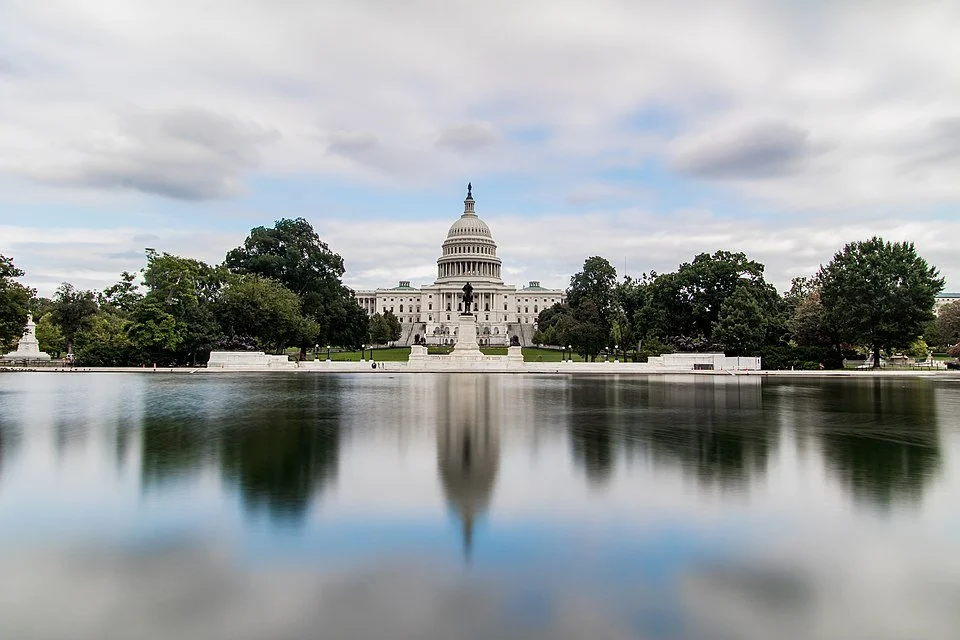
The route leaves the Capitol Reflecting Pool heading west down the National Mall, which means you're on pavement or gravel for the first few miles. The Mall deposits you at the Lincoln Memorial, where the trail hooks north toward the Georgetown Waterfront. This section is paved too, a wide path that hugs the Potomac and fills with cyclists on weekends. It's scenic. It's also crowded.
Things get quieter when you hit the Capital Crescent Trail in Georgetown and you find yourself shaded by trees and separated from traffic. It's a local favorite for a reason. Runners who've logged hundreds of miles on the CCT might not have known they were training on a piece of a cross-country route, but they were.
The CCT eventually meets the C&O Canal Towpath, and this is where the Great American Rail-Trail really starts to feel like something different. The towpath is 184.5 miles of packed dirt and crushed stone that follows the Potomac River from Georgetown all the way to Cumberland, Maryland. It's flat, it's historic, and it's runnable—though "runnable" depends on recent weather. After heavy rain, sections turn to mud. In summer, it's shaded and cool. In winter, it's isolated.
That there is a trail system that spans 3,700 miles across 12 states would surprise most seasoned runners. What's more, the route is more than 55% complete, meaning you can already run over 2,000 open miles that are part of the Great American Rail-Trail system.
The Great American Rail-Trail didn't start with an announcement in 2019. It started with a hunch in the 1980s—a sense that something bigger might be possible if you squinted at the right map long enough.
Rails-to-Trails Conservancy opened its doors in 1986 with a straightforward mission: turn abandoned railroad corridors into public paths. Back then, the rail-trail movement was scrappy and localized. Towns would discover a defunct rail line cutting through their community and think, ‘let’s make it a trail.’ RTC helped them do it. But even in those early days, staff members were tracking these projects on maps, watching as disconnected segments began to form patterns. Rail lines, after all, had been built to connect the country. Maybe trails could do the same.
By the late 1980s, RTC began tracking rail-trail development, noticing something: the outlines of a cross-country route were starting to emerge. The idea sat there for decades, tantalizingly close but not quite viable. The organization set two criteria before they'd commit: a viable route that was more than 50% complete, and a pathway across the west. The eastern half was filling in steadily, but the West—with its rugged mountains and sparse infrastructure—remained the biggest question mark.
Then, in 2016, RTC staff traveled to Wyoming and Montana to explore route solutions in the west. In 2017, preliminary GIS analyses revealed multiple potential cross-country route options between Washington, D.C. and Washington State that were more than 50% complete. The threshold had been crossed. What had been a dream for three decades suddenly became a project with a timeline.
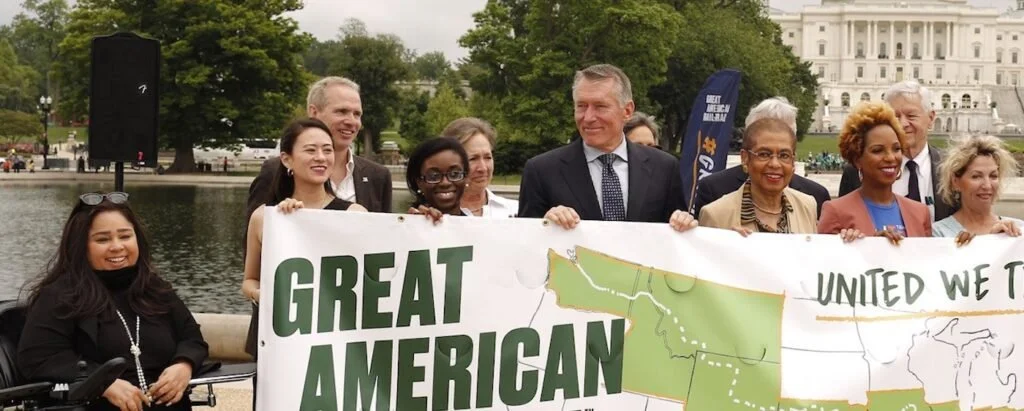
RTC Board Members joined Congresswoman Eleanor Holmes Norton (D-DC) and others at the U.S. Capitol to reveal the Great American Rail-Trail preferred route. | Photo courtesy RTC
On May 8, 2019, Rails-to-Trails Conservancy stood at the U.S. Capitol—the symbolic starting point of the trail—and announced the Great American Rail-Trail to the public. The preferred route: 3,700 miles through 12 states and D.C., composed of more than 150 existing trails with 1,690 miles of gaps left to fill. At launch, the route was already 53% complete. Since then, more than $161 million in public and private funding has been invested in projects along the route.
The vision isn't just about completing segments—it's about fundamentally changing how people think about long-distance travel and active transportation in America. The trail will directly serve nearly 50 million people within 50 miles of the route, turning what used to be recreational corridors into legitimate infrastructure for commuting, tourism, and daily life.
RTC estimates the trail will cost about $1 billion to complete—a figure that will be entirely offset within five years as a result of visitor spending along the route. The timeline for full completion remains ambitious, likely spanning many years as communities secure funding and build out remaining gaps.
The trail will take decades to finish. But here's what matters for D.C. runners: while advocates in Wyoming are fighting for funding and communities in Nebraska are closing gaps, you can lace up your shoes at the Capitol Reflecting Pool and run more than 200 miles west uninterrupted. That's not a plan. That's not a vision. That's already here.
The Great American Rail-Trail is being built from both ends and the middle at once. Someday, when the trail is complete, someone will run the whole thing coast to coast. But until then, every segment matters on its own. And ours happens to start at the Capitol and stretch farther than most people will ever run in a single go.