
What 239,794 Finishers Reveal About the Average Marine Corps Marathon Time
Every year, at the end of October, tens of thousands of runners gather on Route 110 between the Pentagon and Arlington National Cemetery. They wait in the predawn chill for the howitzer blast that sends them off toward Rosslyn, through Georgetown, up Rock Creek Park, through the National Mall and East Potomac Park, and back into Virginia for the final push up the hill to the Marine Corps War Memorial.
The Marine Corps Marathon is affectionately known as “The People’s Marathon” for its sheer size and the fact that it awards no prize money. It draws an egalitarian mix of runners from across the country, including first-timers, military veterans and active duty service members, and seasoned DMV runners who set their Garmin watch by the yearly race.
As we get closer to the race this year, I dug into the timing records made available on the Marine Corps Marathon website from 2012 to 2025. (Note: Marine Corps Marathon was held virtually in 2020 and 2021, so no data is available.) Compiling nearly a quarter of a million individual finish times gave me a detailed look at how the average runner tackles the race, and maybe it will give you a goal to aim for in your own race.
The Big Picture: A Five-Hour Baseline
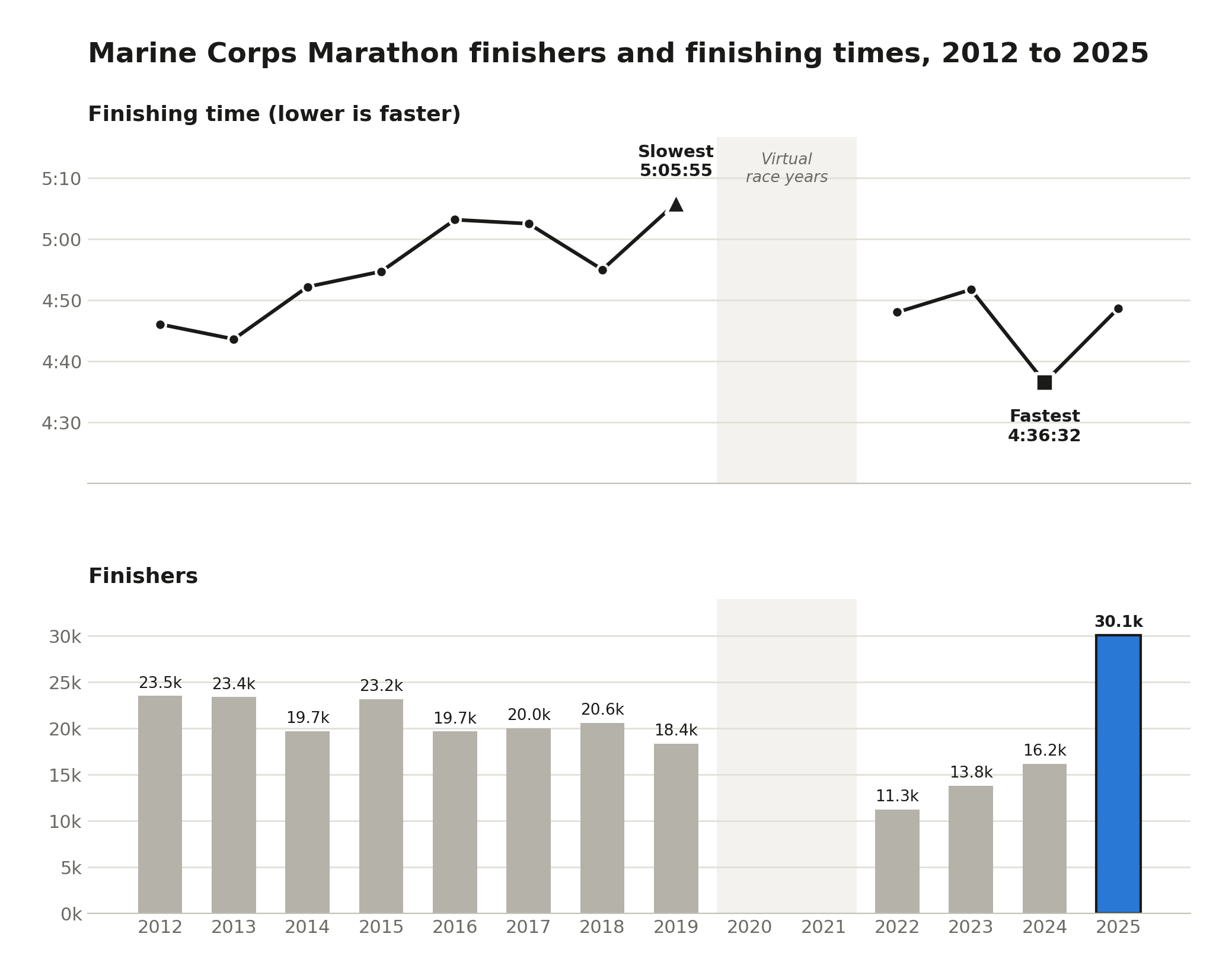
Across all 239,794 finishers evaluated, the overall weighted average finish time is 4:52:19, which translates to a pace of 11:09 per mile. This is an average across all runners, not broken down by gender.
According to the latest 2024 data from RunRepeat’s State of US Marathons 2025, American marathoners are actually getting faster. The national average finish time now sits at 4:34:00 (4:24:00 for men and 4:51:00 for women).
At 4:53:07, the Marine Corps Marathon runs about eighteen minutes slower than that national benchmark. The explanation lies in the distinct character of the event. Because it lacks elite prize purses, the race attracts a remarkably high proportion of debut marathoners compared to major events like Chicago or Berlin. Add in the course topography, including the rolling stretches along 110, the windy open expanse of the 14th Street Bridge, and that final uphill punch to the monument at mile 26, and the field average settles comfortably around the five-hour mark.
Source: Marine Corps Marathon Results
Most Common Marathon Finishing Times
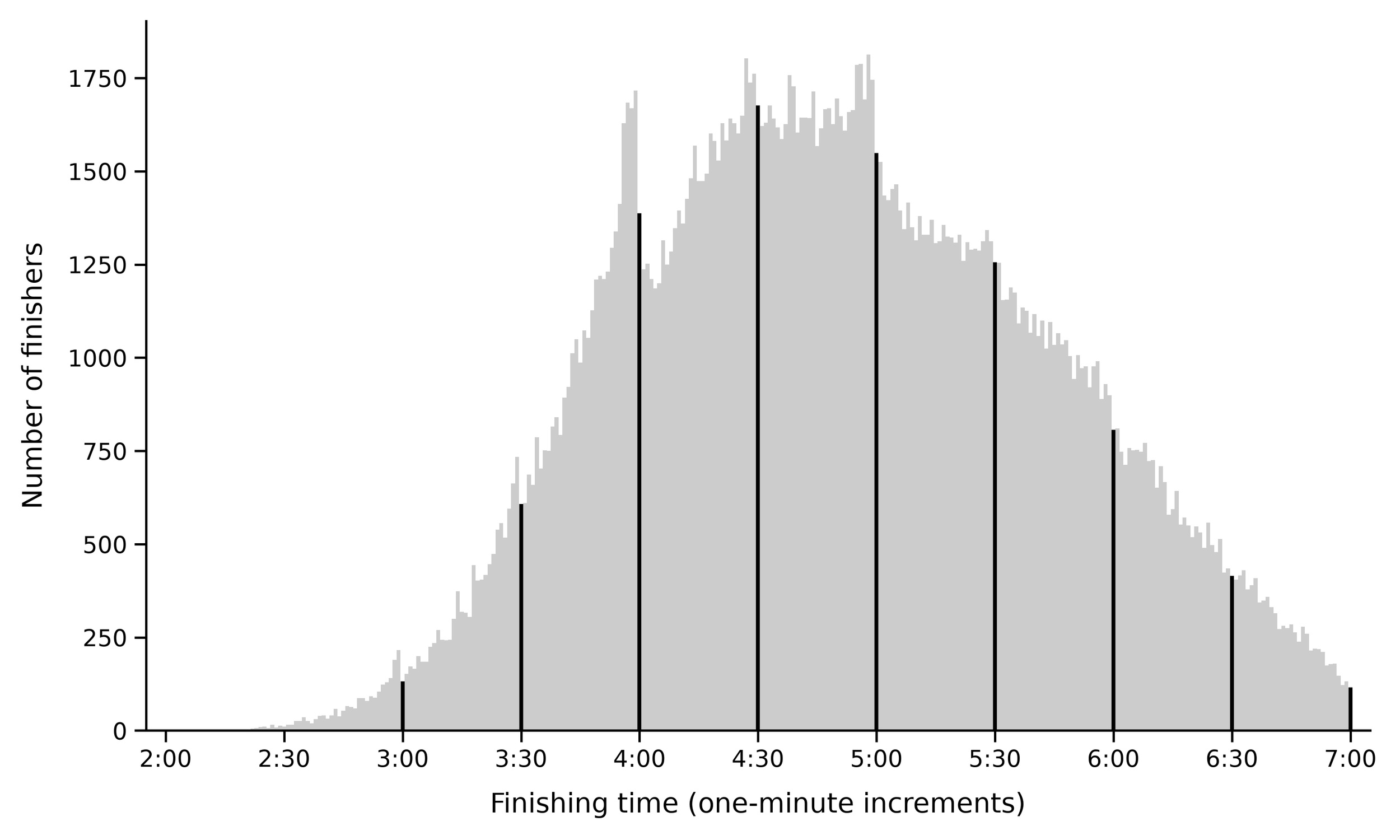
After charting twelve years of MCM results, I also batched them into one-minute intervals to determine the times with most finishers.
Finishers pile up in the minute just before each half-hour milestone, marked in black on the chart below, then thin out as soon as the clock turns over. At every half-hour mark from three hours to six and a half, more runners crossed in the minute before it than in the minute after. The drop is steepest at four hours, where 1,716 runners finished in 3:59 and only 1,387 in 4:00. A sub-four-hour finish may be the coveted target, but the busiest stretch of the race comes in the final minutes before five hours. More runners crossed the line at 4:58 than at any other minute, 1,812 in all. That reflects the race's identity as an accessible event heavily populated by first-timers, where the collective pace is more relaxed.
Source: Marine Corps Marathon Results
Analysis of more than nine million marathon times conducted by researchers at the University of Chicago backs this up. They found that runners most often finish just before a round number finishing time. In his graph below, you can see peaks in finishers crossing the line at 2:59, 3:29, 3:59, and 4:29.
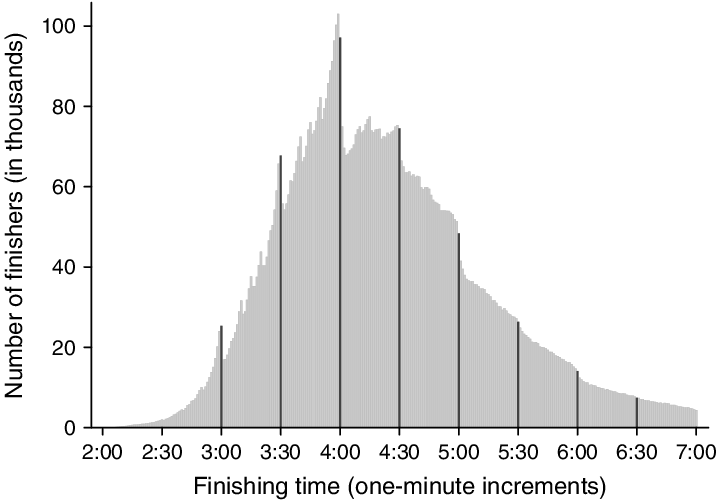
Goals as Reference Points in Marathon Running: A Novel Test of Reference Dependence - Scientific Figure on ResearchGate. Available from: https://www.researchgate.net/figure/Distribution-of-Marathon-Finishing-Times-n-9-789-093_fig2_314476528 [accessed 24 Sept 2026]
This phenomenon can be explained by loss aversion, a cognitive bias where the psychological pain of losing something is about twice as intense as the pleasure of gaining an equivalent thing. In other words, the idea of finishing a sub-four-hour marathon is far more enticing than finishing in 4:01, which pushes runners to work harder as they near the finish.
The Post-Pandemic Trajectory
The most striking trend in the data is the magnitude of the post-pandemic resurgence.
When the in-person race returned in 2022 after two years of virtual formats, participation plummeted to 11,259 finishers. Lingering travel hesitation, deferred registrations, and adjusted field caps created the smallest field in recent history and the smallest field I pulled as part of this dataset.
Despite this low-water mark, the race swiftly recovered:
2022: 11,259 finishers (4:48:00)
2023: 13,819 finishers (4:51:43)
2024: 16,167 finishers (4:36:32)
2025: 30,085 finishers (4:48:40)
By 2025, participation had nearly tripled from the 2022 low.
What is particularly impressive about 2025 is that despite the massive field size, the average time held strong at 4:48:40 (11:01/mile pace).
According to RunRepeat, marathon participation in the United States is five percent higher than pre-pandemic levels.
What This Means for Your Marathon
If you are thinking about your MCM taper or calibrating your targets, these numbers offer practical context:
Do not judge your fitness against flat courses. The initial climb into Rosslyn requires discipline, the concrete underfoot around the monuments can be unforgiving, and the bridge crossing back into Virginia often brings head-on winds and the monotonous pounding of feet with no crowds to drown it out. An 11:09 pace is the true middle of the pack here.
Respect the weather forecast. A ten-degree rise in start-line temperature or high humidity along the Potomac can easily swing collective finish averages by fifteen to twenty minutes. Looking at the data, we can see the effects the swampy, rainy weather in 2019 and the 80-degree heat in 2016 had on finishing times. Pay close attention to hydration points.
The crowd carries you through the finish. While a field of 30,000 runners requires patience in early corrals, that massive density creates an unmatched atmosphere through the final miles in Crystal City and along the Pentagon boundary. There is no better finish than the Marine Corps War Memorial hill. Embrace the cheering crowds and full send.
Whether your goal is breaking three hours, slipping under the four-hour mark, or conquering the course to earn that finisher medal, you are sharing the pavement with one of the most dedicated running communities in the country.